 The Assurance Desk
New UK guidance asks schools to look again at how they share and protect photos and videos of pupils. It follows reports of criminals using AI tools on school images, and a blackmail attempt against one secondary school.
What does the new guidance ask schools to do?
The UK Online Harms Early Warning Working Group has updated its image security guidance. It did so after reports of criminals targeting schools and using AI tools on pupil images.
The guidance is for education settings and other organisations that work with children. It shares best practice and points to consider, to address the risk of AI image manipulation.
It covers how photos and videos of children are managed, shared and protected. That includes images on school websites, social media and other digital spaces.
It sets out practices to protect pupils' images, the risks of using them online, and a checklist of actions to consider.
It also explains what to do if images are misused, altered or abused. Further resources include a guide to removing EXIF metadata and an example risk management template.
Page 1 of the guidance for education settings, from the UK Online Harms Early Warning Working Group.
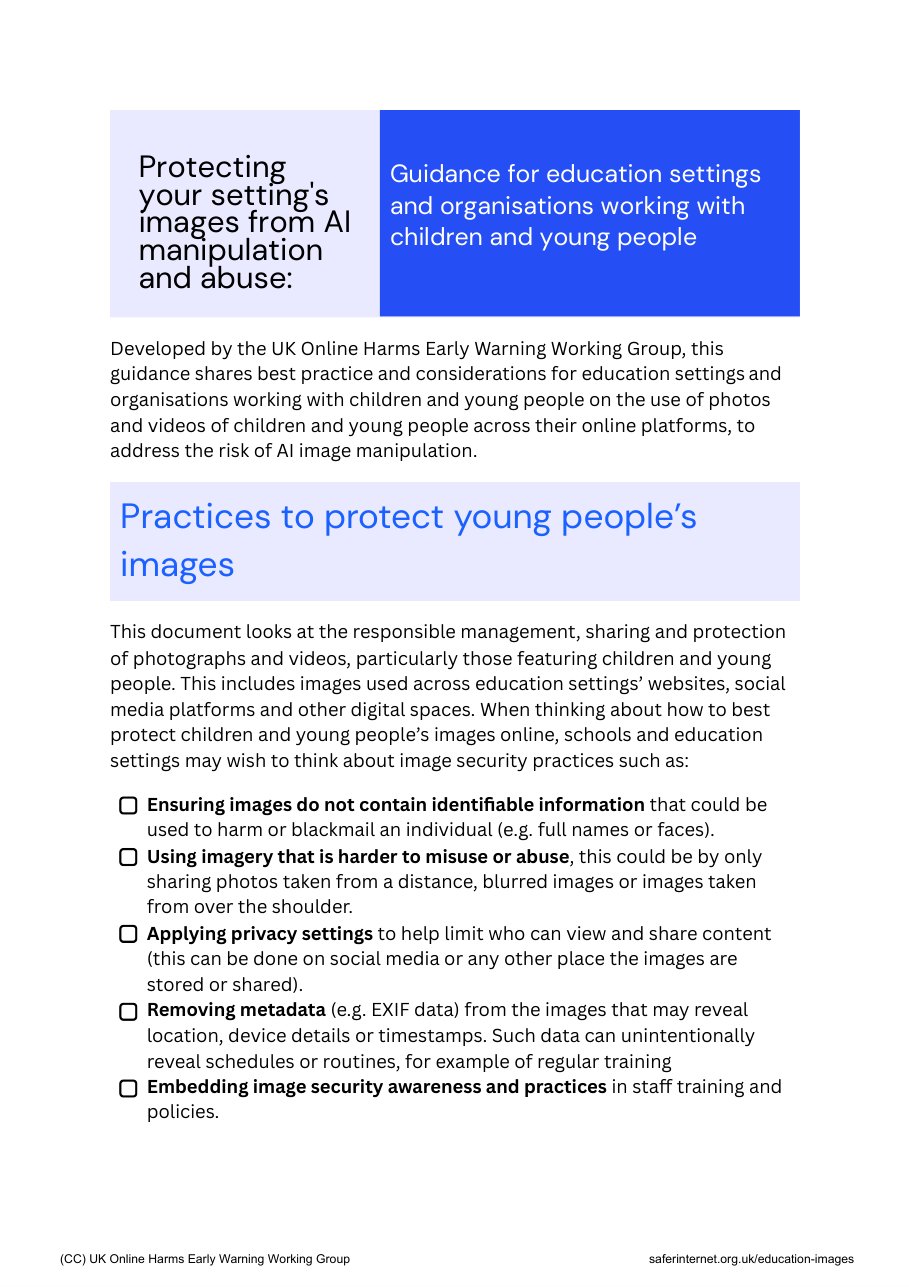
The page lists five practices schools may wish to think about. Ensure images do not contain identifiable information that could be used to harm or blackmail an individual, such as full names or faces. Use imagery that is harder to misuse, such as photos taken from a distance, blurred images or images taken from over the shoulder. Apply privacy settings to limit who can view and share content. Remove metadata, such as EXIF data, that may reveal location, device details or timestamps. Embed image security awareness and practices in staff training and policies.
(CC) UK Online Harms Early Warning Working Group. Uncropped page 1 of the published guidance, shown for news reporting. Captured 19 October 2026. View full size
What happened at the school behind the warning?
Images of children were taken from a secondary school's website and altered using AI tools. UK police asked the Internet Watch Foundation, a member of the working group, to help block their spread.
The blackmailers sent the material to the school. They threatened to share it more widely unless the school paid them money.
Incidents like this do not yet appear to be widespread. The working group's concern is that more schools will be targeted in the same way.
Pupils are not the only people at risk. Adult staff at schools and pupils over 18 can also be targeted in this way.
What should a school do if it is targeted?
Do not engage with anyone who tries to blackmail the school, and contact the police straight away. Paying a ransom demand can be illegal in certain circumstances.
The guidance gives staff a checklist to recognise and respond to image based abuse. It puts pupils' safety, dignity and emotional wellbeing first.
Removal tools can help. The guidance highlights the IWF and Childline's Report Remove tool for under 18s, among other measures.
The law is clear on the images themselves. In the UK, images and videos of child sexual abuse are illegal whether they were made with AI or not.
If a blackmail attempt reaches your school
- Do not engage Do not engage with anyone trying to blackmail the school.
- Call the police Contact the police straight away.
- Do not pay Paying a ransom demand can be illegal in certain circumstances.
- Put pupils first Use the checklist, with pupils' safety, dignity and wellbeing first.
- Use removal tools Help under 18s use the IWF and Childline's Report Remove tool.
How does this fit the data protection rules you already follow?
The data protection rules have not changed. If someone can be recognised in a photo, it is usually their personal data.
Data protection law is likely to apply to photos taken for official school use, such as a prospectus. You need a valid lawful basis before taking, using or sharing them.
Department for Education guidance lists public task, consent and legitimate interests as lawful bases. The ICO expects most publicly funded schools to be looking at public task.
Tell pupils, or a parent or guardian, how the photos will be used. Explain at the outset which lawful basis you rely on.
People can still say no. The ICO recommends an opt out whatever the lawful basis, and pupils or parents can opt out even under public task.
A photo may need to come down from the website if a pupil objects. Existing paper copies of a prospectus do not necessarily have to be destroyed.
Some existing steps sit close to the AI risk. Check that permissions cover new ways of sharing images, including AI tools, and carry out a DPIA for new systems.
The ICO's page on photos in schools is under review, because of changes made by the Data (Use and Access) Act.
Data protection steps for school photos that already apply
- Publish a clear photo and video policy alongside your privacy notice
- Take extra care with social media; many schools collect specific consent for it
- Do not publish photos of pupils who should not be publicly identified
- Check that permissions cover new ways of sharing images, including AI tools
- Carry out a DPIA when you introduce new systems or platforms
- Train staff regularly to avoid the risk of a breach
An AI example of a safer team photo. Not a real school or real pupils.
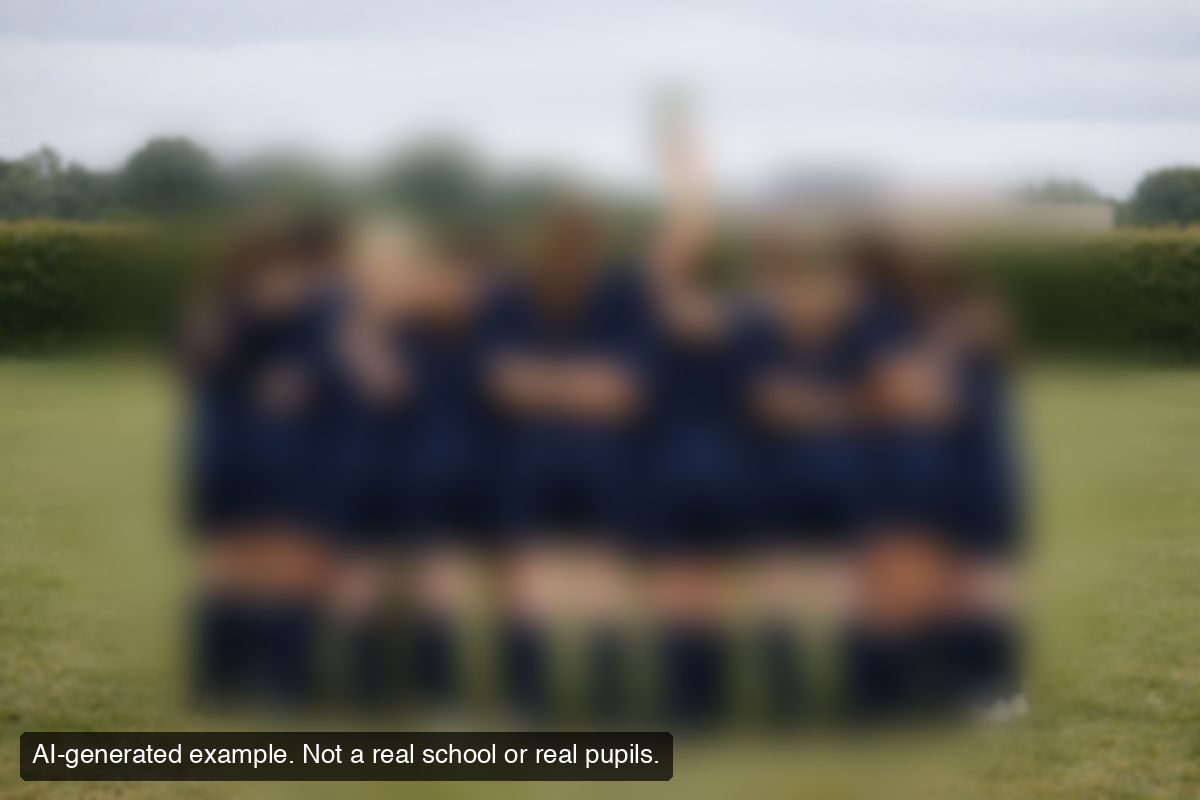
An illustration made by The Assurance Desk with an AI image tool on 19 October 2026, then blurred and labelled. The team is shown from behind, everyone is blurred and no names appear. The guidance lists photos taken from a distance, blurred images and images without full names or faces as ways to make images harder to misuse. It is an example only, not a school's real photo.
AI-generated example by The Assurance Desk, blurred and labelled. Not a real school or real pupils. Captured 19 October 2026. View full size
What are parents being told?
The IWF and the National Crime Agency have also issued guidance for parents and carers. It aims to help them share children's images safely.
It includes advice on talking to children about AI, deepfake nudes and image consent. It also covers what to do if a child is targeted.
The NCA asks parents to review privacy settings and think about who can see their children's images. It also asks them to talk with schools and clubs about image sharing and consent.
So expect questions from parents. The ICO suggests sharing your photo policies at the start of the academic year, including how to opt out.
Images shared online, even everyday family photos, can be stolen and manipulated to create sexualised content without a child or parent's knowledge.
Read next
Sources
- UK Online Harms Early Warning Working Group, Protecting your setting's images from AI manipulation and abuse (PDF, May 2026), checked 19 October 2026
- saferinternet.org.uk, Image guidance for education settings, UK Safer Internet Centre, checked 19 October 2026
- saferinternet.org.uk, Schools given advice on image safety to keep ahead of threat from AI blackmailers, UK Safer Internet Centre, checked 19 October 2026
- GOV.UK, Data protection in schools, Taking and using photos and videos, and using CCTV in schools, Guidance, checked 19 October 2026
- ICO, Taking photographs: data protection advice for schools, checked 19 October 2026
- nationalcrimeagency.gov.uk, New guidance for parents and carers as AI-manipulated images of children become a growing concern, National Crime Agency, checked 19 October 2026
- ICO, Taking photos in schools, checked 19 October 2026
This is an independent editorial guide, not legal advice.