 The Assurance Desk
Part of the guide UK GDPR’s seven principles, in plain English
Start with the risk to people
The organisation deciding why and how data is used is called a controller. A processor handles data on its behalf. Article 32 requires both to put appropriate security measures in place.
Look at the data, what you do with it and the harm people could face if something goes wrong. The law also takes account of available technology and the cost of putting measures in place. The result must still be security that is appropriate to the risk.
Security reaches beyond computers. The ICO includes physical measures, such as controlling access to premises, and organisational measures, such as clear staff procedures.
What does suitable security look like?
People should only be able to access, change, share or delete data within the authority you give them. Records also need to remain accurate, complete and usable.
These examples turn those aims into questions for a team. They are prompts to adapt to the actual data and risks, not a fixed list for every organisation.
| Possible problem | Example safeguard | Useful check |
|---|---|---|
| Someone sees records they do not need. | Restrict access to the people who need it. | Can someone outside that role open the records? |
| Paper files can be taken from an open room. | Control access to the room or storage. | Who can get in, and when? |
| A device or system fails. | Keep an appropriate backup and recovery process. | Can the team restore access to usable records? |
| Staff follow different rules when sharing data. | Give staff clear procedures and training. | Can staff explain the approved way to share it? |
Can you restore the data when something goes wrong?
Article 32 includes the ability to restore access to personal data in a timely way after a physical or technical incident. Think about recovery as well as preventing unauthorised access.
Cybersecurity specialist Lisa Forte makes a useful point about relying on several layers of protection. Her LinkedIn comment is an expert view, not a separate legal requirement.
The ICO checklist below puts recovery beside testing. The useful question is whether the measures work when needed, and what happens after a test finds a problem.
Resilience can never be one layer thick!
The ICO checklist connects recovery with regular testing and action.
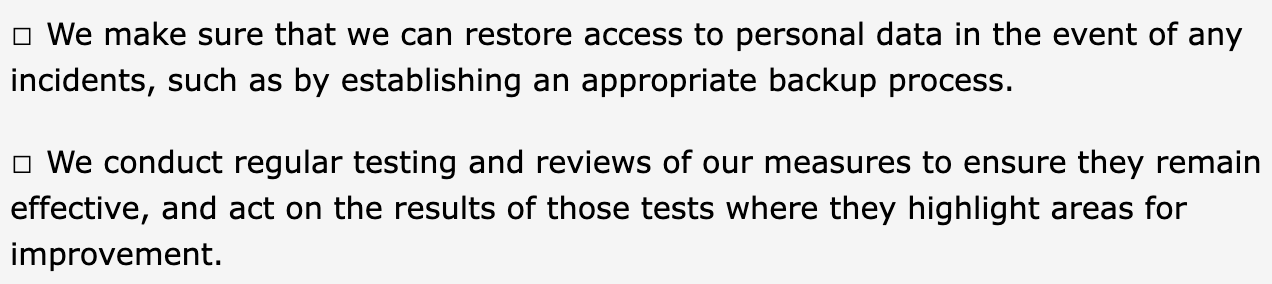
The first item says an organisation should be able to restore access to personal data after an incident, for example through an appropriate backup process. The next says to test and review measures regularly, then act on results that reveal areas for improvement. The excerpt is text from the guidance, not a record of a completed assessment.
Information Commission’s Office, A guide to data security, latest listed update 19 May 2023, licensed under the Open Government Licence v3.0. Captured 9 October 2026. View full size · Image licence
How often should you test security?
Testing needs to be regular. Its type and frequency depend on your organisation and the data it handles. The ICO says to document the results and act on recommendations, or record valid reasons for another approach with appropriate safeguards.
For example, a team could plan a recovery exercise, record what it could restore, and assign any fixes it finds. This is an example exercise to discuss, not a claim about how often your system needs testing.
Make security an ongoing job
- Assess Identify the data, its use and the risks to people.
- Protect Put suitable technical and organisational measures in place.
- Test Check whether the measures work and record the results.
- Improve Act on findings and keep the measures under review.
What if a supplier holds the records?
If you choose a processor, the ICO says it must provide sufficient guarantees about security measures. A useful buying discussion asks what the supplier protects, what it tests and what evidence it can show.
The ICO marks its security guidance as under review after the UK’s Data (Use and Access) Act. The risk, recovery and testing duties above are also set out in the UK GDPR text.
What to do
- Describe the personal data and the risks to people.
- Check access, physical protection and staff procedures.
- Plan how access would be restored after an incident.
- Test the measures, record results and follow up findings.
- Ask a processor for evidence of suitable security.
Common questions
Is Article 32 just about IT?
No. It covers technical and organisational measures. The ICO also includes physical security and what staff do when handling data.
Do we have to encrypt personal data?
The ICO recommends encryption for personal data stored or sent over the internet. It should be part of a policy that considers the remaining risks too. Assess what is appropriate for the data and its use, rather than treating encryption as the whole security plan.
Where next
Sources
- ICO, A guide to data security, checked 9 October 2026
- legislation.gov.uk, Regulation (EU) 2016/679 of the European Parliament and of the Council of 27 April 2016 on the protection of natural persons with regard to the processing of personal data and on the free movement of such data (United Kingdom General Data Protection Regulation) (Text with EEA relevance), checked 9 October 2026
- Lisa Forte on LinkedIn, When it comes to cyber security be careful your assessed level of resilience isn’t based on sales promises from vendors. So often I see plans and playbooks based off of sales promises of tools and…, checked 9 October 2026
- ICO, Copyright and re-use of materials, checked 9 October 2026
- legislation.gov.uk, Regulation (EU) 2016/679 of the European Parliament and of the Council of 27 April 2016 on the protection of natural persons with regard to the processing of personal data and on the free movement of such data (United Kingdom General Data Protection Regulation) (Text with EEA relevance), checked 9 October 2026
This is an independent editorial guide, not legal advice.